
Most leadership offsites produce the same outcome: a polished deck, a list of agreed priorities, and a room full of people who privately believe the real problems were never discussed. Six weeks later, the silos are intact. The misalignments are back. And the organisation runs another offsite to fix what the last one didn’t.
That’s not a people failure. It’s a method failure.
The Real Silo Problem Isn’t What You Think
Leaders always frame silos as a communication breakdown between different function; Sales VS Product or Marketing Vs finance, each speaking a different language
So the instinct is to gather everyone into a room, run a facilitated discussion, and reach a consensus.
But the problem goes deeper.
The deeper issue is that people across functions have built fundamentally different mental models of the same organisation and have no reliable way to surface or compare them.. This stops them from reaching an agreement on the definitions of success and problems within the organization,
When the only means of communication is through words, we only hear those elements of the picture that we feel comfortable saying out loud; therefore, those statements do not include the entire picture.
Why More Talking Doesn’t Help
Research on group dynamics shows that verbal discussions, are dominated by the confident ones and not necessarily the most informed ones It is likely that the quiet thinkers are someone who see the problem most clearly, and they are the ones who never utter a single word in such meetings.
This is how silos get reinforced inside the very meetings designed to break them. The dominant narrative wins. The non-dominant view, which might really give a good insight to your team gets edited out before anyone even realises it.
Corporate training in India and globally has many times tried to fix this with facilitated workshops, team assessments, and profiling tools, it definitely helps. But they still rely on language as the primary medium. And language is a filter as much as it is a bridge.
What LEGO® Serious Play® Actually Does
LEGO® Serious Play® (LSP) is not a recreational team-building workshop . It’s a certified facilitation methodology that is developed with extensive research into how people construct and share complex knowledge, especially under pressure.
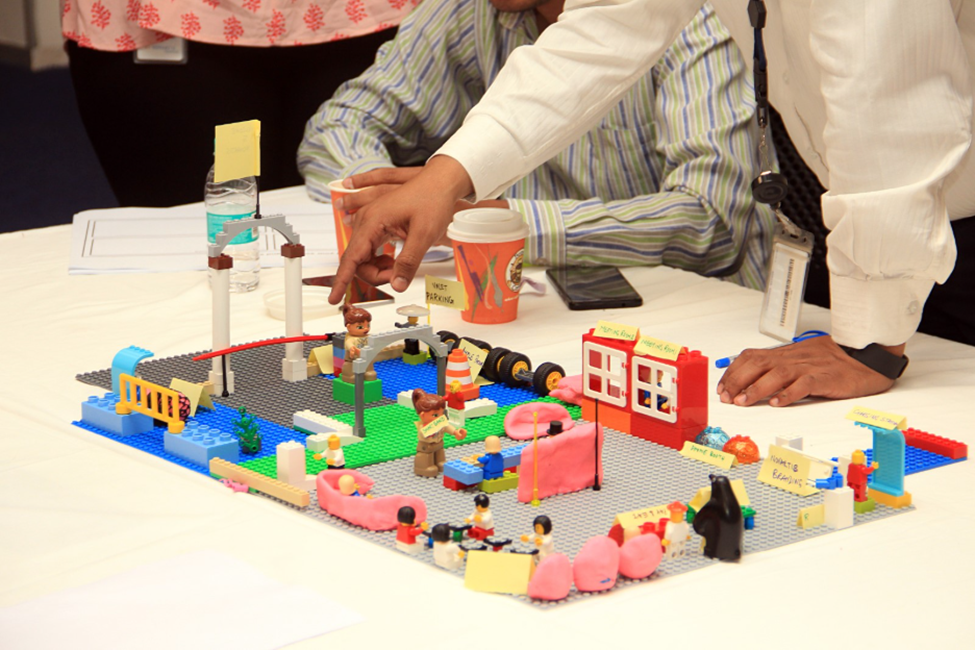
The core principle is simple and counterintuitive: Participants build their answers to a strategic question using LEGO® bricks, in three dimensions. Every participant then presents the ‘story’ of their model and the listeners ask questions based on the model they see. This becomes a new way of communication for them.
Here’s what happens when you do this:
Everyone is invested, everyone builds, everyone can speak. The person who used dominate and spoke the most in verbal meetings, can’t interrupt when a model is being constructed. The quiet genius can put out his thinking in a form that demands engagement from the room.
The three-dimensional models are shared objects, visible to everyone, this is something the group can look at, question, probe, and connect with.
The Neuroscience Leaders Should Know
Research shows that the 70-80% of our neural nerves in our hand are directly connected to our brain, meaning that the act of building physically externalises knowledge that verbal communication alone rarely surfaces.
This is what certified LEGO® Serious Play® facilitators call “thinking through your fingers.”
The outcomes of LEGO® Serious Play® workshops differ from the outcomes of a regular brainstorming session. This difference represents how the brain processes difficult, ambivalent or multi-faceted problems.
The part of our brain that enables us to formulate, develop and communicate responses is limited in nature. When a roomful of people is asked to “discuss strategy,” they tend to loose a part of their thought. This is because “discussing strategy” means communicating complex thoughts concurrently, while under the pressure of social components in the room.
Building with LEGO® bricks will allow the externalization of unconscious thoughts. As one builds, it creates a fundamental shift in the dynamics of the conversation, from defending versus seeking or exploring.
This is why LEGO® Serious Play® in India is being used by organisations not just for team building workshops, but for strategy alignment sessions, change management conversations, and cross-functional problem-solving at the leadership level.
What Changes After a Well-Facilitated LSP Session
The output of a LEGO® Serious Play® workshop is not a report. It’s a shared understanding, this is not something that can be put into paper and mailed to everyone who weren’t present.
When senior leaders who have built models of their own challenges and have used it to communicate with each other , a lot changes in how they interpret each other’s decisions afterward.
They have a reference point that’s richer than a slide, more honest than a survey, and more memorable than a facilitated discussion.
Teams who go through this, notices three consistent shifts:
- Assumptions are eliminated from High stake converstions.
When everyone gets a chance to share their point view, assumptions are no more a constraint in conversation, it is a 100-100 meeting where everyone gets to tell and ask based on the model, and not designations. - Decision-making gets faster.
What would have taken months of brainstorming sessions, can get a solution or direction after only one workshop
- Ownership increases.
Decisions that emerge from LEGO® Serious Play® sessions carry real ownership — because every person in the room had a hand in building them,
Why Certification Matters — and What to Look For
Not every LEGO® Serious Play® session is the same. The methodology has a rigorous certification process. Certified facilitators go through multi-day training, working through the core Application Techniques and learning how to design progressively deeper question sequences for different organisational contexts.. A leadership workshop session moves teams through three levels: it goes from individual model building, to shared team landscapes, to systemic organisational challenges. A certified LEGO® Serious Play® facilitator knows how to sequence those levels.
CtrlX’s LEGO® Serious Play® workshops are run by certified facilitators who design each session specifically around your challenge, not an agenda that is applied to every organisation.
One Question to Ask Before Your Next Offsite
At your last leadership session, did every person in that room leave with the same understanding of the problem, or did they leave with their own version of it?
Most leadership teams, if honest, would choose the second option.
A half-day LEGO® Serious Play® workshop, focused on one real organisational tension, consistently surfaces more than months of facilitated discussion. Not because it’s novel, but because it’s designed to externalise what people actually think, not just what they’re willing to say.
The question is not whether alignment matters. It does. The question is whether what you’re currently doing is capable of creating it.
CtrlX LEGO® Serious Play® Workshops — What to Expect
CtrlX offers certified LEGO® Serious Play® workshops, leadership development coaching, and experiential training programmes for senior teams across India.
- Workshop duration: 4 hours to 2 days
- Group size: 6–12 participants for maximum depth
- Format: In-person (Hyderabad, Bengaluru and across India)
- Use cases: Strategy alignment, team building, change management, cross-functional problem solving, leadership offsites
If you’re looking for a LEGO® workshop near you in India — or want to bring an experiential approach to your next leadership workshop — we’re worth a conversation.