
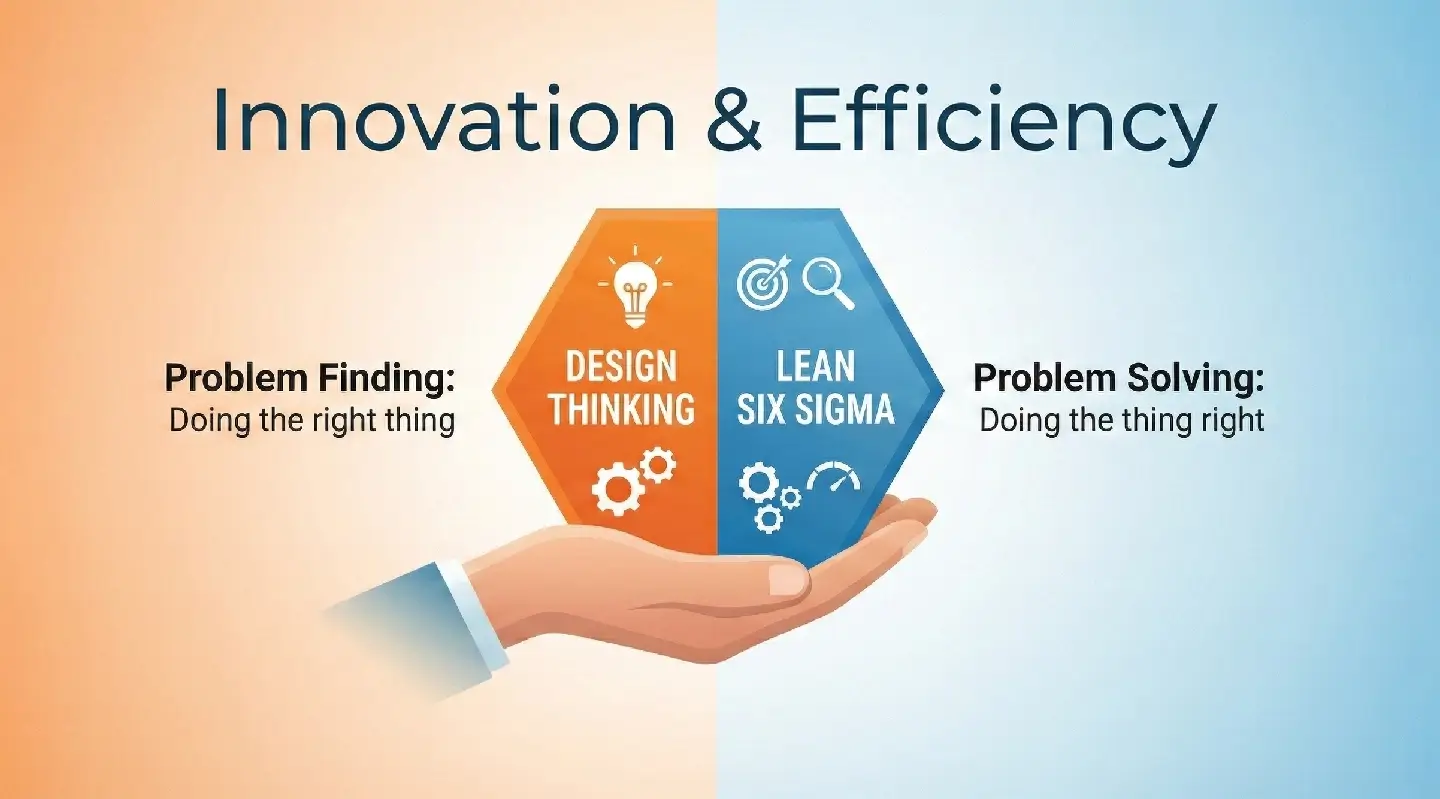
In today’s competitive and rapidly changing business environment, organizations must balance creativity with operational efficiency. Design Thinking enables teams to understand latent user needs and generate innovative solutions, while Lean Six Sigma brings structure, discipline, and data-driven rigour to problem-solving. When applied together, these approaches help organizations reduce waste, improve customer experience, and develop solutions that deliver sustainable value. This blog explores how Design Thinking and Lean Six Sigma complement each other, why they work best together, and how organizations can integrate both frameworks effectively.
Design Thinking and Lean Six Sigma: Why Combine These Two Approaches?
For a thorough understanding of these two approaches, here is what you should know:
What is Lean Six Sigma?
Lean Six Sigma is a data-driven methodology that helps organisations eliminate non-value adding steps and reduce variation; it uses DMAIC (Define, Measure, Analyse, Improve, Control) framework, which is a structured problem-solving methodology utilizing data and process analysis tools to achieve breakthrough improvements. Many leading organisations have reported significant savings, improved efficiency, and customer satisfaction as a result of adopting Lean Six Sigma.
What is Design Thinking?
Design Thinking is a human-centred approach to innovation. It is an iterative process of developing innovative solutions by understanding the customer deeply, brainstorming creative ideas, building tangible prototypes and refining the prototype through iterative testing and validation. Organizations that have a Design Thinking mindset often notice a significant increase in breakthrough ideas, higher user acceptance, faster product launch, and improved cross-functional collaboration. Enterprises have shown that structured design techniques can enhance customer satisfaction, loyalty, and market responsiveness.
What Happens When They Work Together?
When combined, Design Thinking and Lean Six Sigma create a competitive advantage for organisations. Where they stop guessing and start solving the right problems in the right way. Design Thinking help teams identify the correct problems to resolve and solutions that customers really want. Lean Six Sigma then ensures these solutions are converted into reliable, efficient and scalable processes.
How Can Indian Organisations Benefit?
Combining Design Thinking and Lean Six Sigma can help businesses operate more efficiently and serve customers better. It brings together clear thinking, creativity, and efficiency, which is particularly helpful in cost-sensitive and competitive markets, such as India. Here are some of the ways it benefits the Indian businesses:
- Faster Delivery at Less Cost: Lean techniques can eliminate unnecessary delays and steps. This enables businesses to save time and money without compromising quality, which is essential for Indian companies that must manage operational costs
- Better Acceptance by Users: Design Thinking ensures the focus on actual consumer needs, expectations, and habits. Well-run design thinking workshops can help organizations train their teams understand the users deeply so that the final solution feels familiar, helpful and easy to use.
- Higher Returns on Investment: When processes start to improve and customer needs are fulfilled, businesses realise higher revenues. Organisations often launch faster, with fewer iterations, and register higher profits because they are solving the correct issues in the right manner.
- Stronger Collaboration Across Departments: This combined strategy motivates cross-functional teams to communicate and collaborate on ideas. Everyone uses the same language and objectives, which reduces confusion and improves decision-making.
Lean Six Sigma and Design Thinking: A Helpful Illustration
To facilitate a clearer understanding of this integrated approach, here is a brief
Hospital example
Employing Design Thinking, the team conducts interviews with patients and identifies that the underlying issue is inadequate appointment communication, which generates anxiety and confusion prior to their arrival.
They collaboratively develop and evaluate a more effective calling script, along with SMS and email reminders, refining them iteratively until patients perceive the messages as clear, reassuring, and straightforward to respond to.
The Role of Lean Six Sigma
- Lean Six Sigma subsequently assesses waiting durations, missed appointments, and front-desk errors, maps the process, and eliminates unnecessary steps in registration and scheduling.
- The enhanced script and reminder process are standardized, data-driven, and subject to ongoing refinement, resulting in reduced wait times, decreased no-show rates, and increased patient satisfaction scores.
Tips for Teams That Are Just Starting Out
If you have recently started using this combined approach, it is important to follow these useful tips:
- Train a small cross-functional pilot team. Include an individual who understands data, someone with user research skills, and an operations owner.
- Use simple metrics (cycle time, defect rate, and NPS) that everyone can track.
- Run short experiments, such as two-week sprints for Design Thinking prototypes, followed by a DMAIC cycle to stabilise improvements.
- Share the wins and lessons learned across locations, from small, visible successes to building momentum.
Conclusion
Combining Lean Six Sigma with Design Thinking can help create a balanced path. This pairing offers Indian businesses a practical and simple way to grow efficiently and keep consumers happy. However, before opting for this approach, it’s important to take up a credible Lean Six Sigma certification in India along with structured learning. CtrlX® is one provider that offers this certification and other programmes that introduce Design Thinking.
Our Lean Six Sigma Black Belt Certification and Green Belt Certification develop participants into expert problem solvers who lead strategic projects.
Looking to Solve Complex Business Challenges?
Explore Lean Six Sigma and Design Thinking workshops that help teams innovate, improve processes, reduce inefficiencies, and deliver measurable business results.
Contact us to design outcome-driven problem-solving workshops aligned with your organisational goals.