
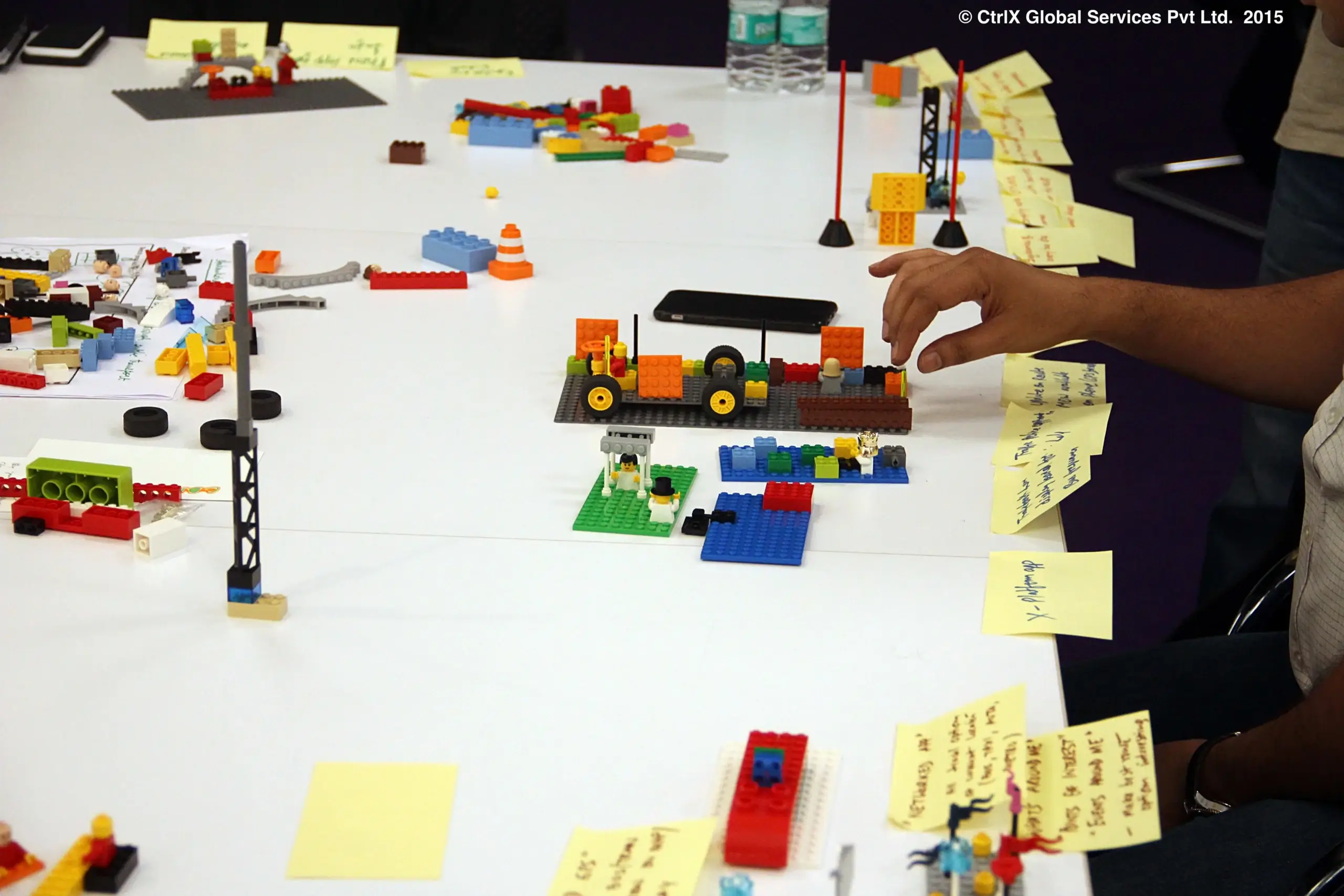
In leadership alignment and strategy workshops, we repeatedly see the same pattern: the challenge is rarely a lack of expertise. It is a lack of shared understanding.
Senior leaders frequently exit workshops with a consensus on principles, yet they interpret decisions variably upon resuming their roles. Execution fails not due to an unclear strategy, but because assumptions were never collectively articulated. This is where traditional workshops have trouble, and where hands-on learning is most useful.
As businesses deal with increasingly complex problems across strategy, culture, and customer experience every day, workshops need to do more than just a brainstorming exercise. They need to help groups craft a shared understanding, unearth complexity, visualize the big picture, explore connections and get buy-in.
The Problems with Traditional Workshops
Many traditional corporate workshops are still designed to share information, even when the objective is alignment and decision-making. These workshops work well when the goal is to share information through presentations, expert input, and guided discussions.
Some common structural problems are:
- Cognitive overload: Presentation-based sessions overload the working memory, making it hard to retain and comprehend what was discussed.
- Unequal participation: These meetings unknowingly follow the 80-20 phenomenon, where 80% of the speaking is done by only 20% of the participants; that’s when most of the important views are not heard.
- Abstract conversations: Ideas like strategy, culture, or customer experience are still abstract and can be interpreted differently by each participant.
- Low emotional ownership: Alignment stays more about ideas than actions.
- Weak follow-through on execution: Ideas sound good in the room, but they are forgotten after the workshop ends.
These are problems not only impact the workshop outcome, but also increase the execution risk for the leadership teams.
Why Learning by Doing Works Better
Hands-on, minds-on learning creates an environment where participants change from passive listeners to active sense-makers. Teams don’t just talk about problems; they think, build, test, and share them.
Studies on experiential learning and LEGO® SERIOUS PLAY® show that people learn more when they use their hands to think.
By “thinking through their fingers,” participants externalize tacit knowledge, mental models, and assumptions that seldom emerge in verbal discourse alone.
In real life, this means:
- More thought and understanding
- Better memory retention
- Faster agreement among all parties
- Better choices based on a common understanding
Experiential learning isn’t the same as playing. It’s a method for structured thinking and shared perspectives.
When hands-on learning isn’t always the best way to learn
Hands-on methods don’t work for everyone. We don’t use LEGO® SERIOUS PLAY® when the problem is only technical, based on rules, or needs one-way information transfer.
We use it when achieving alignment is more important than having a quick solution. This difference- of doing the right thing the right way and implementing the fast way- is vital, however often overlooked by leaders.
LEGO® SERIOUS PLAY®: From Talking to Group Understanding
LEGO® SERIOUS PLAY® is a structured, research-based methodology that is used for leadership workshops, strategy, innovation, and team problem solving.
When you search “Lego Workshops,” it is important to know the difference between recreational sessions and professional certified LEGO® SERIOUS PLAY® facilitation that is specifically designed to help with organizational problems.
In leadership sessions, the method follows a strict order to avoid reaching a premature decision, which is a common problem in executive discussions:
Participants make models in response to well-framed challenge questions.
Participants convey meaning through storytelling rather than debating.
Individual viewpoints are incorporated into a collective framework or “landscape.”
Teams look at different situations, dependencies, and strategic choices.
The LEGO® models are neutral objects that help people represent their ideas instead of them doing it themself. This makes people feel safe, even when talking about sensitive or emotional subjects.
Why LEGO® SERIOUS PLAY® Works Better for Team-Based Problem Solving
Everyone should take part.
This environment is where 100% of the speaking is done by 100% of the participants. Every participant builds and contributes, making sure that everyone is on the same level and that decisions are based on the group’s mutual understanding.
Understanding Complicated Business Problems
Abstract problems like strategy trade-offs, cultural tensions, and gaps in customer experience are made clear and open to discussion, which helps everyone get on the same page.
What Usually Happens in the Room
The change usually happens when separate models are put into a shared system during a session. What first looked like alignment often turns out to be hidden trade-offs, like conflicting priorities, resource tensions, or risks that aren’t spoken about. This is usually the point where the best decisions are made.
More Determination to Act
Teams take more ownership and follow through after the workshop because they helped create the outcomes instead of having them forced on them.
Who Gets the Most Out of This Method
LEGO® SERIOUS PLAY® team building workshops work best for leadership teams that are:
- Finding your way through strategic uncertainty or change
- Having problems working with people from other departments
- Changing the way you do business or how customers feel about it
- Aligning after a lot of growth, a reorganization, or a change in leadership
These aren’t problems with training. There are problems with getting the organization to work together.
How CtrlX Plans High-Impact Hands-On Minds-On Interventions
At CtrlX®, we use LEGO® SERIOUS PLAY® as a strategic facilitation and consulting tool, not as a training methodology. .
When companies want to conduct a LEGO® SERIOUS PLAY® workshop, they should only work with certified facilitators who know how to apply global best practices to the local business environment.
Most of the time, traditional workshops focus on talking about problems in an intellectual way. Companies that get employees to think and move at the same time can get them to think more deeply, work better together, and get sustainable results.
We plan each engagement based on the client’s business situation, leadership realities, and goals. These could be aligning strategy, developing leaders, coming up with new ideas, or changing the culture.
The goal is always the same: to get leadership teams to go from having different points of view to having a clear one, and then to take action based on that clarity.
In conclusion
Discussions are the most important part of traditional workshops. Hands-on Minds-on approaches lets participants think together and act with intention, In todays fast paced world where business success is driven by both insight and execution, using experiential methods like LEGO® SERIOUS PLAY® for strategy development and problem solving can be a game-changer. The approach does not replace strategic thinking; it makes the strategy visible, shared, and actionable.
Struggling With Alignment After Workshops?
If your leadership workshops create agreement in the room but confusion afterward, it’s time to rethink the approach.
Contact us to explore hands-on learning customized interventions that turn shared understanding into decisive action.