
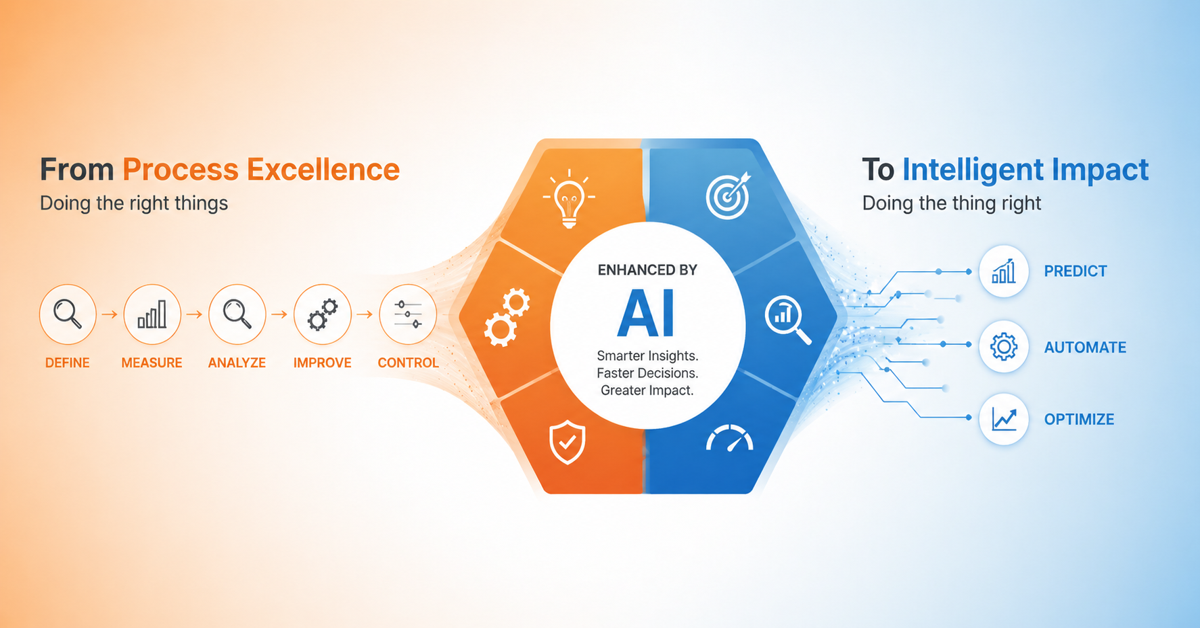
There is a common misconception that the implementation of AI leads to the disappearance of process problems. They don’t. If anything, AI exposes process weakness faster than anything we’ve seen before.
Organisations that incorporate automation into undefined workflows don’t experience transformation. It’s faster chaos. Reports are generated more quickly. Dashboards multiply. Predictions look impressive. However, the same variation, rework, and confusion continue underneath, just at digital speed.
That’s exactly why Lean Six Sigma has remained relevant and has become more critical.
AI Doesn’t Fix Broken Systems
Artificial intelligence can analyse data at scale. It can identify correlations that humans would miss. It can reduce manual effort dramatically.
What it cannot do is clarify ownership. It cannot resolve process ambiguity. It cannot replace intuitive thinking.
If teams are unclear about what “good” looks like, AI won’t define it for them. If inputs are inconsistent, the outputs will be inconsistent too, just more confidently presented.
The primary purpose of Lean Six Sigma was never to establish control; it was about giving leaders clarity, by defining the problem, measuring only what matters, and analyzing root causes, which results in deliberate improvements, sustained discipline and overall control.
That structure becomes even more important in AI-heavy environments.
Why Lean Six Sigma Certification in India Still Has Momentum
Despite rapid AI adoption, leading Indian organizations continue to invest in Lean Six Sigma certification, particularly at the black belt level, to strengthen governance around automation initiatives.
Automation software and services are currently in high demand in a diverse array of industrial sectors. However, automation without process maturity introduces operational risks such as amplified variations, compliance exposure and misalignment between teams. Substantial financial investments in automation technologies are being made in these three sectors: technology companies, shared service centers, and financial institutions.
Lean Six Signa is no longer bound for the manufacturing industry. Through its capability development initiatives, the programme equips leaders with the critical skills that are required to navigate the digital transformation.
Operational Excellence Consulting Has Evolved
Before, operational excellence consulting was primarily concerned with defect elimination and cost reduction. The current conversation has shifted to a different subject.
The present discussion encompasses three components: automation readiness, data governance, and AI integration.
Companies allocate their resources for the acquisition of AI tools that are specific to their departments. Marketing implements predictive analytics. Automation is essential for operations. Forecasting algorithms are implemented in finance. The systems operate autonomously to accomplish local objectives; however, the absence of coordination results in global operational complications.
Process design is employed in the operational excellence consulting method to establish a direct connection with technology implementation. The system compels individuals to respond to challenging enquiries.
The workflow must achieve a stable state prior to the commencement of automation. The performance metrics facilitate cross-functional alignment among various functions. Before beginning the digitization process, the team must understand the different variations. AI should enhance decision velocity and precision, and not scale inconsistency. AI should not contribute to the spread of organisational inconsistency.
A Practical Example
To enhance service delivery efficiency, the service organization implements artificial intelligence (AI) technology to automate ticket distribution. The preliminary findings indicate that there is potential for success. Unfortunately, customer complaints persisted. After a thorough investigation, the issue was not originated with routing logic.
The issue was present even before this implementation. Team members were employing different standards to categorize tickets. Teams implemented diverse methodologies to understand escalation protocols. Consistency was lacking in the documentation of resolution processes.
The AI system’s capacity to direct both accurate and inaccurate system inputs enable it to perform efficient routing operations.
The Lean Six Sigma intervention generates a comprehensive workflow mapping solution that defines specific handoff points and establishes standard classification procedures, all while eliminating redundant tasks.
After the AI system has been established in an optimised operating condition, it will commence to generate tangible benefits. The process must be fully developed before technology can produce superior results. This is a hypothetical scenario, which frequently occur across organisations at different levels.
Why Competitive Advantage Still Comes from Process Discipline
Organisations that sustain an advantage over time tend to share one trait: operating clarity. They understand how workflows work. They measure the right variables. They build accountability into systems instead of depending on heroics.
AI improved those organisations exponentially dramatically. In contrast, organisations that operate with informal agreements and reactive fixes struggle when AI results are inconsistent.
Lean six sigma black belt certification builds leaders who can navigate through this complexity. They distinguish signal from noise within structured governance frameworks. And that difference can be seen in the results.
Process Excellence in an AI-Driven Future
There’s no doubt AI will continue evolving. Predictive models will become more accurate. Automation will become more seamless. Generative tools will enter more functions.
But competitive advantage won’t belong to the companies with the most AI licenses. It will belong to those who combine digital capability with process integrity.
Professionals in technology, healthcare, logistics, and financial services are increasingly enrolling in for Six Sigma courses in India. That is not nostalgia; it is realism grounded in experience. When environments become more complex, structured thinking becomes more valuable, not less.
Lean Six Sigma doesn’t compete with AI. It prepares organisations to use it responsibly.
Ready to Strengthen Process Excellence in the AI Era?
Connect with our experts to explore Lean Six Sigma certification or operational excellence consulting tailored to your digital transformation goals.
Contact us If your organisation is accelerating AI adoption, the real question is not tool selection, it is process readiness. That is where disciplined operational design becomes a strategic differentiator.